
China's Stock Market Sees Over ¥1 Trillion Wiped from Tech Giant Changxin Memory as US Inflation Fears Trigger Broad Selloff
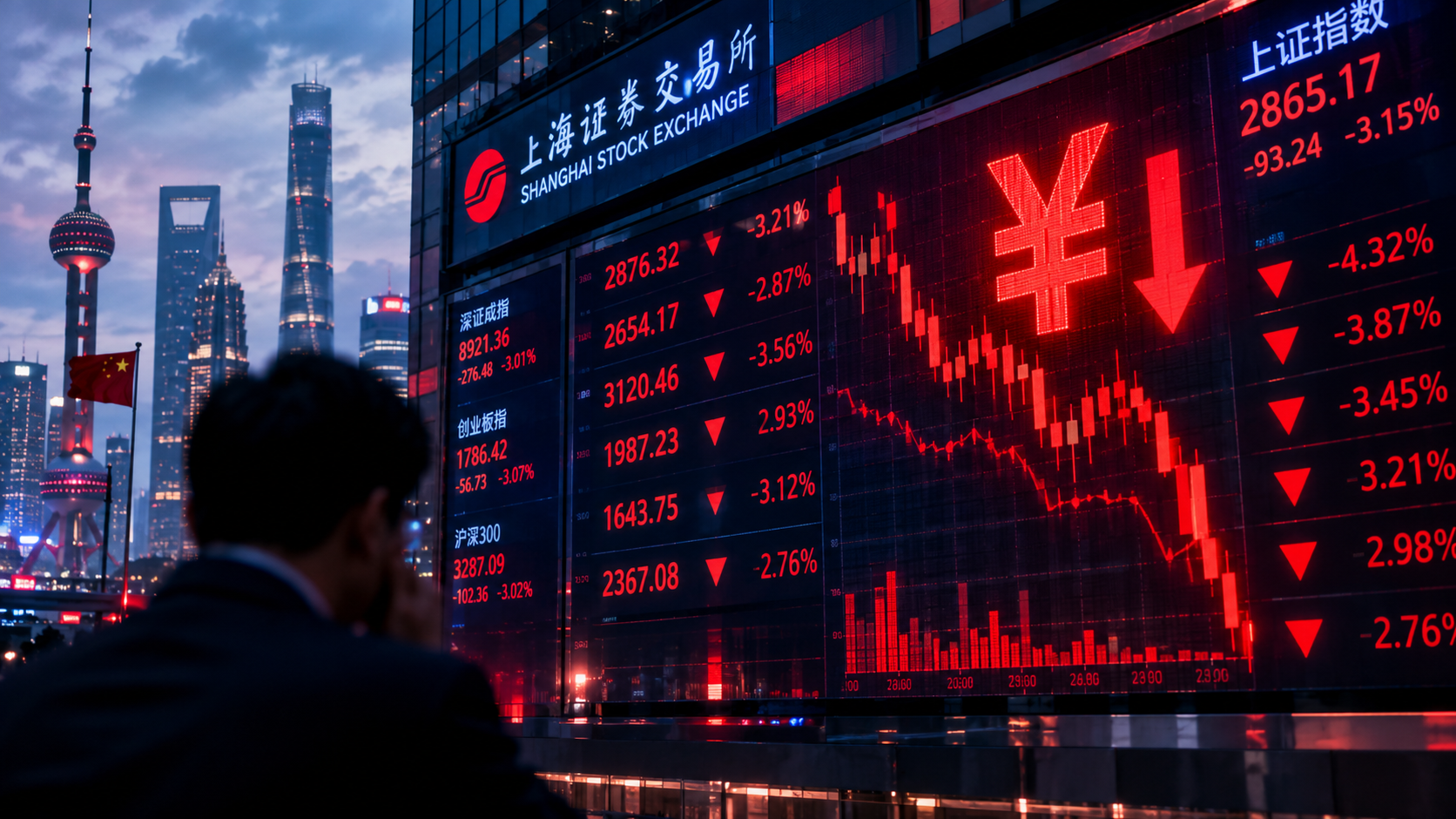
Beijing — Chinese equities tumbled on Thursday, October 15, 2026, with technology stocks leading a broad decline that erased hundreds of billions in market value, as hotter-than-expected US inflation data revived fears of prolonged high interest rates and triggered a wave of selling across Asian markets.
The benchmark Shanghai Composite Index fell 1.59% to close at 3,707.48 points, while the Shenzhen Component Index dropped 2.43% and the tech-heavy ChiNext Index plunged 2.92%. More than 5,100 individual stocks declined across the mainland bourses, with combined turnover reaching ¥1.65 trillion.
The Changxin Memory Meltdown
The most dramatic single-company story came from Changxin Memory Technology (CXMT), China's largest DRAM manufacturer, which saw its market capitalization fall below ¥3 trillion after a 5.24% decline on the day. The stock closed at ¥43.59 per share, ceding its position as the A-share market's most valuable company to Industrial and Commercial Bank of China (ICBC), which reclaimed the top spot with a market cap of approximately ¥3.03 trillion.
The fall marks a stunning reversal for Changxin Memory, which had surged to the top of China's stock market immediately upon its listing on July 27, 2026. By August 17, its market capitalization had reached ¥4.2 trillion (approximately $843 billion). In the roughly two months since, the company has shed approximately ¥1.07 trillion in market value—a decline of over 25%.
The company, viewed as a strategic counterweight to South Korean and American semiconductor giants in the memory chip space, has been caught in a broader reassessment of artificial intelligence infrastructure stocks. Analysts cited concerns over whether the massive capital expenditure required for AI data centers is sustainable at current valuations.
US Inflation Data Sparks Global Risk-Off
The immediate catalyst for the selloff was the release of US Consumer Price Index data for September, which showed a 3.7% year-over-year increase—exceeding market expectations of 3.6% and rising from 3.4% in August. The hotter print intensified expectations that the Federal Reserve may need to raise interest rates further, or at minimum maintain a restrictive policy stance for longer than previously anticipated.
The inflation reading sent US Treasury yields and the dollar higher, drawing capital away from risk-sensitive emerging market assets. South Korea's KOSPI and KOSDAQ indices plummeted by 7.57% and 7.65% respectively on the same day, underscoring the regional scope of the risk-off sentiment.
Sector-by-Sector Breakdown
The damage was concentrated in technology and growth-oriented sectors:
Semiconductors and communications equipment led losses, with the STAR 50 Index—tracking Shanghai's tech-focused board—dropping 3.9% in early trading.
AI infrastructure stocks were hit particularly hard: optical module maker Eoptolink Technology fell 7.5%, while Zhongji Innolight dropped 5.2%.
Memory and chip stocks: GigaDevice Semiconductor declined 4.9%, and Cambricon Technologies, a prominent AI chip designer, fell 3.4%.
Defensive sectors provided a rare bright spot. The baijiu (Chinese liquor) sector rose against the trend, with Huangtai Liquor hitting the daily limit-up. Banking and insurance stocks also gained: ICBC rose 0.59%, Agricultural Bank of China added 1.1%, and Ping An Insurance gained 1.1%.
Shipping and energy stocks suffered a separate blow from reports that the United States may ease sanctions on so-called "shadow tanker fleets," potentially increasing oil shipping capacity and pressuring freight rates. China Merchants Energy Shipping and COSCO Shipping Energy Transportation both hit limit-down.
Market Context: A Correction, Not a Collapse?
The selloff extends a broader retreat in Chinese equities that began after the Shanghai Composite peaked at around 4,200 points in early May 2026—an 11-year high. The index has since declined steadily, and Thursday's close marked its lowest level in 14 months.
Some analysts characterized the decline as a necessary deleveraging and valuation correction within the technology sector rather than a systemic crisis. UBS Securities China equity strategist Lei Meng noted that "the recent pullback seems to be driven more by a concentrated unwinding of elevated tech crowding," while also citing pressures from mutual fund redemptions and tighter dollar liquidity.
Former Haikai Fund chief economist Yang Delong argued that the AI technology revolution's "major development trend remains unchanged," describing the decline as "bubble squeezing and valuation contraction" rather than a fundamental reversal.
However, the scale of the Changxin Memory decline—more than ¥1 trillion in two months—highlights the vulnerability of companies whose valuations became tethered to AI infrastructure optimism. With the memory chip maker now trading well below its peak, the market appears to be demanding clearer evidence that the AI buildout can deliver returns commensurate with the capital being deployed.
Chinese investors now turn their attention to third-quarter GDP data due Monday for signals on whether the broader economy can provide a counterweight to the technology sector's troubles.
Sources
- Reuters — China stocks fall as US inflation data triggers broad selloff, October 15, 2026
- Bloomberg — Changxin Memory loses top spot as tech selloff deepens, October 15, 2026
- Caixin — Shanghai Composite closes at 14-month low, October 15, 2026
- Reuters — Asian markets slide as US CPI exceeds expectations, October 15, 2026
Disclaimer: This article is for informational purposes only and does not constitute investment advice.