
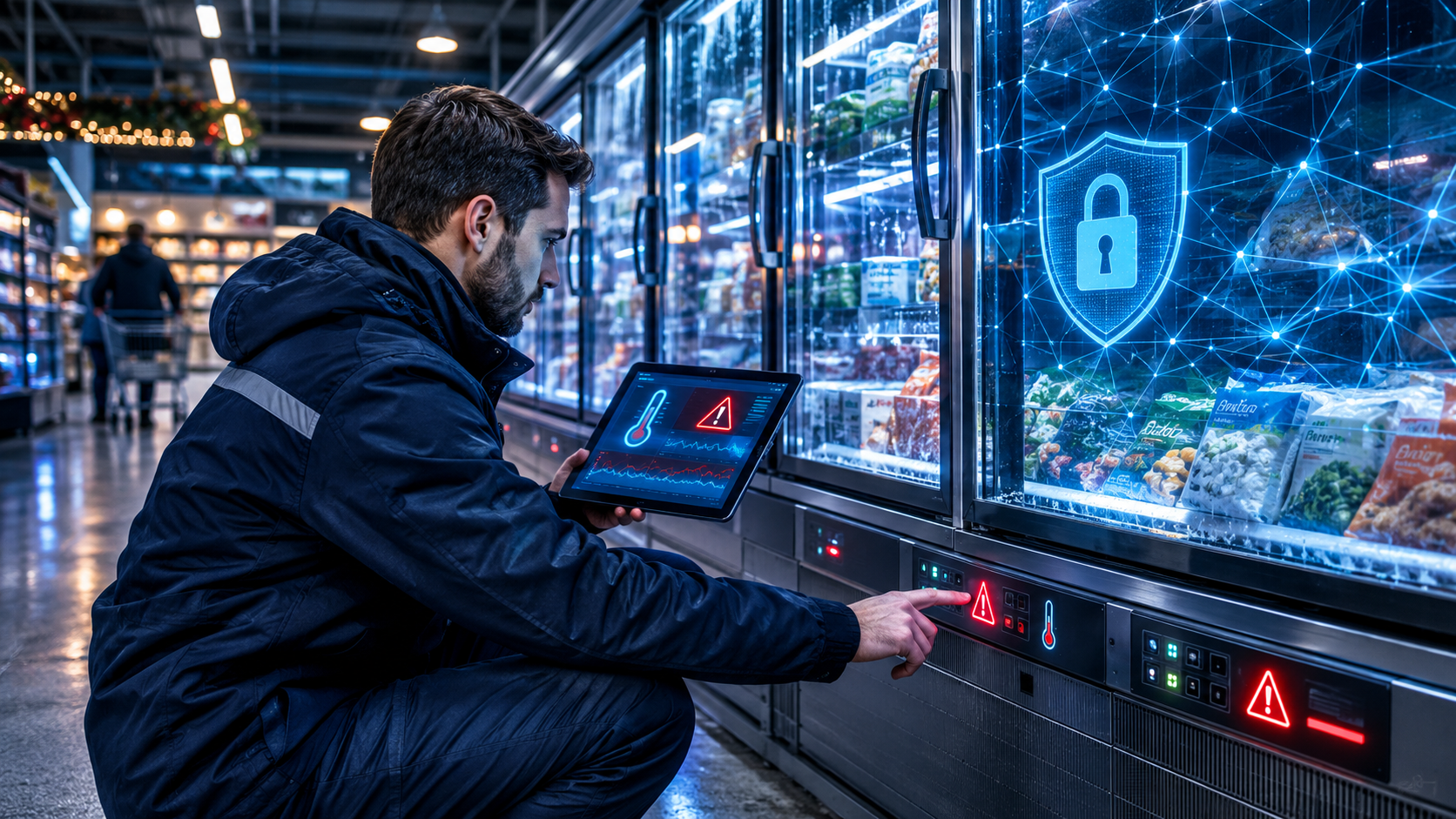
Cyberattacks Hit Supermarket Freezers Across 7 European Countries, Raising Food-Safety Fears
A series of reported cyberattacks targeting refrigeration systems at supermarkets and food businesses across Europe is raising fresh concerns about the security of critical retail infrastructure. Incidents have been reported in seven countries, with stores experiencing unusual temperature changes, disrupted freezer settings and, in some cases, the disposal of chilled and frozen food.
The countries identified in the reports include the Netherlands, Finland, Belgium, Sweden, Luxembourg, Ireland and Estonia. The reported incidents involve supermarkets, butcher shops and cold-storage facilities, suggesting that the issue extends beyond individual retail locations.
Belgium appears to have experienced some of the most significant reported disruption. Around 40 Delhaize stores, 15 Carrefour locations and five Spar outlets were reportedly affected. Temperatures in some refrigeration units reached approximately 15°C, resulting in frozen products being discarded. Estimated losses were reported at no less than €100,000.
In Sweden, supermarket refrigeration settings were also reportedly altered. One ICA store allegedly recorded a freezer setting of +50°C, while some locations experienced food disposal and temporary closures.
The reports were highlighted by Coin Bureau in a November 2 social media post. However, the full scope of the incidents, the responsible attackers and whether all seven countries experienced activity from the same campaign have not yet been independently established.
The developments are particularly concerning because refrigeration systems are essential to food safety. A cyberattack that changes temperature controls can create financial damage and potentially compromise products intended for consumers.
Seven European Countries Reportedly Affected
The reported incidents cover a range of supermarket chains and food businesses. While the scale differs between countries, the common concern is interference with systems responsible for maintaining safe refrigeration temperatures.
Here is a breakdown of the reported incidents:
| Country | Reported locations and businesses | Reported impact |
|---|---|---|
| Netherlands | At least 17 businesses, including butcher shops and cold-storage facilities | Refrigeration systems reportedly targeted |
| Finland | Some K Group stores | Temporary overnight temperature irregularities |
| Belgium | Around 40 Delhaize, 15 Carrefour and 5 Spar stores | Temperatures reportedly reached 15°C; frozen products discarded |
| Sweden | ICA and Coop stores | One ICA freezer reportedly had a +50°C setting; food discarded and some stores closed |
| Luxembourg | Around 65 stores, including several Delhaize locations | Refrigeration-related incidents reported |
| Ireland | 13 SuperValu stores | Chilled and frozen goods withdrawn; financial losses expected |
| Estonia | Major supermarket chains | A freezer reportedly set to +50°C, but rapid intervention prevented damage |
These figures come from the circulating reports and should be treated as preliminary. They do not yet establish a complete, independently verified count of affected businesses or the total financial damage.
Belgium Reports More Than 60 Affected Supermarket Locations
Belgium is among the countries facing substantial reported disruption.
According to the figures shared by Coin Bureau, approximately 40 Delhaize stores, 15 Carrefour locations and five Spar outlets experienced refrigeration-related incidents.
Some refrigeration units reportedly reached temperatures of around 15°C. That is far above the temperatures normally required to keep frozen products safely stored.
The reported consequences included the disposal of frozen goods and financial losses estimated at a minimum of €100,000.
For supermarket operators, the damage can extend beyond the cost of the discarded products. Stores may also face inventory replacement expenses, operational disruption, equipment inspections and additional food-safety checks.
The exact number of products affected and the final financial impact have not yet been established.
Sweden: Freezer Settings Reportedly Changed to +50°C
Reports from Sweden describe another unusual development.
ICA and Coop stores were reportedly among the affected businesses. In one particularly concerning case, an ICA store allegedly found that a freezer's temperature setting had been changed to +50°C.
Such a setting is far outside the normal operating range for a commercial freezer. If the equipment follows the altered setting, it could stop maintaining the low temperatures needed to preserve frozen food.
Some stores reportedly discarded products, while others temporarily closed.
The incident raises an important question about how refrigeration systems are managed remotely and whether unauthorized users can change operational settings without being detected quickly.
A temperature change does not automatically prove that food was unsafe in every affected location. Food-safety decisions depend on the actual temperature history, the type of product and the time it remained outside safe storage conditions.
Netherlands, Finland and Ireland Also Report Disruptions
The Netherlands has reportedly seen incidents involving at least 17 businesses, including butcher shops and cold-storage facilities.
The involvement of cold-storage businesses is particularly significant because these facilities play a role in the wider food supply chain. They store products before distribution to retailers, restaurants and other customers.
In Finland, some K Group stores reportedly experienced temporary overnight temperature irregularities. Even when a disruption is detected quickly, overnight incidents can create challenges because fewer employees may be present to monitor equipment.
Ireland has also been included in the reports, with 13 SuperValu stores allegedly affected. Chilled and frozen products were withdrawn, while the financial losses were expected to reach thousands of euros. The exact temperature readings were not disclosed in the social media report.
Luxembourg reportedly recorded incidents across approximately 65 stores, including several Delhaize locations.
In Estonia, major supermarket chains were reportedly affected by freezer-setting changes. One unit was allegedly set to +50°C, but the supplier said rapid intervention prevented product damage.
These different outcomes underline the importance of how quickly a temperature abnormality is detected and corrected.
Why Are Refrigeration Systems Becoming a Cybersecurity Concern?
Commercial refrigeration is no longer just a collection of standalone cooling machines.
Modern supermarket systems can include digital controllers, connected sensors, remote monitoring platforms and building-management software. These tools allow operators to monitor temperatures, manage equipment and respond to technical problems across multiple locations.
Connectivity can improve efficiency, but it also introduces cybersecurity risks.
If attackers gain unauthorized access to a poorly secured control system, they may be able to interfere with settings or disrupt normal operations. The consequences can be physical rather than limited to stolen data or unavailable websites.
A successful intrusion into a refrigeration control environment could potentially:
- Change temperature settings.
- Disrupt cooling operations.
- Interfere with temperature monitoring.
- Disable or delay alerts.
- Create operational problems across multiple locations if systems share common access infrastructure.
These are potential attack scenarios, not confirmed technical details of every incident currently being reported.
The exact method used in the European cases has not been established in the information available so far. It would therefore be premature to claim that attackers exploited a specific vulnerability, compromised a particular supplier or used ransomware.
Could This Be Connected to the October Attacks in France?
The latest reports have drawn comparisons with refrigeration-related attacks reported in France during October.
Those earlier incidents were described as causing significant damage to food products, with losses reportedly reaching millions of euros.
The similarities have raised questions about whether the latest incidents are part of a wider campaign targeting supermarket refrigeration infrastructure.
However, similar outcomes do not prove that the attacks share the same operators, malware or technical method.
Investigators would need to compare network activity, access logs, compromised credentials, affected equipment and other digital evidence before establishing a connection.
For now, the October incidents in France provide relevant context, but a direct link to the seven countries mentioned in the latest reports remains unconfirmed.
The Food-Safety Risk Goes Beyond Financial Losses
A refrigeration failure can quickly become a food-safety issue.
Supermarkets rely on controlled temperatures to preserve meat, seafood, dairy products, frozen food and other temperature-sensitive goods. If a refrigeration system stops working properly, the time spent outside the required temperature range becomes critical.
Food operators generally need to assess the actual temperature readings and duration of exposure before deciding whether products can remain on sale.
This is why some retailers may withdraw products even when the final cause of a temperature change is still being investigated.
The potential consequences include:
Product disposal: Food that cannot be confirmed as safe may need to be removed from sale.
Supply disruption: Stores may need replacement inventory from suppliers, potentially affecting availability.
Operational costs: Equipment inspections, technical support and temporary closures can increase expenses.
Consumer confidence: Repeated incidents may raise questions about how retailers protect food storage systems.
The reported attacks therefore highlight a cybersecurity issue with consequences that can reach directly into everyday shopping and the food supply chain.
What Supermarkets and Suppliers Need to Review
The incidents could increase pressure on retailers and refrigeration suppliers to examine how connected equipment is protected.
Security measures that may help reduce the risk include stronger authentication for remote access, restricting access to control systems, separating operational technology from ordinary corporate networks and monitoring unusual changes to equipment settings.
Temperature alerts should also be designed to identify abnormal readings quickly, including outside normal business hours.
Retailers may need to review who can remotely change refrigeration settings and whether every change is recorded in an auditable system.
Suppliers also have an important role. If multiple businesses use similar equipment or management platforms, a weakness in a shared service could potentially create risks across several locations.
However, no specific supplier vulnerability or common technical weakness has been confirmed in the current reports.
What Happens Next?
The immediate priority for affected retailers is to verify equipment conditions, assess product safety and restore normal refrigeration operations.
The wider investigation will need to establish how the systems were accessed, whether unauthorized changes were made remotely and whether the reported incidents are connected.
Authorities and cybersecurity teams will also need to determine whether the attacks were financially motivated, intended to disrupt operations or part of a broader campaign. There is not enough confirmed information at this stage to attribute the incidents to a particular country, hacking group or political motive.
For the retail sector, the larger lesson is that cybersecurity now extends beyond payment systems, customer databases and online shopping platforms.
A connected freezer may appear to be an ordinary piece of store equipment, but if its controls are accessible through digital networks, it can become part of a business's cybersecurity exposure.
The reported incidents across seven European countries show why protecting operational technology is increasingly important. As supermarkets connect more equipment to remote management systems, securing those systems will be essential not only for business continuity but also for protecting the food supply.
Frequently Asked Questions
Which European countries have reported refrigeration-related cyberattacks?
Reports shared on November 2 identify the Netherlands, Finland, Belgium, Sweden, Luxembourg, Ireland and Estonia. The full scope and official confirmation of each incident remain subject to further reporting.
How many supermarkets were affected in Belgium?
The circulating report lists approximately 40 Delhaize stores, 15 Carrefour locations and five Spar stores, with refrigeration-related disruption reported across those locations.
Why are hackers targeting supermarket freezers?
The motive behind the reported incidents has not been confirmed. Unauthorized access to connected refrigeration systems could disrupt operations or damage products, but investigators have not yet established the attackers' objectives.
What happened to the freezers in Sweden?
The reports say that ICA and Coop stores experienced incidents. One ICA freezer was allegedly set to +50°C, while some stores reportedly discarded food or temporarily closed.
Were frozen food products destroyed?
Yes, food disposal was reported in Belgium and Sweden. In Ireland, chilled and frozen products were reportedly withdrawn. In Estonia, rapid intervention was said to have prevented damage.
Are the European incidents connected to the October attacks in France?
The reported incidents have similarities, but no confirmed technical or investigative link has been established in the information currently available.
Can a cyberattack really affect physical supermarket equipment?
Yes. Connected industrial and building-management systems can control physical equipment, including refrigeration units. If unauthorized access occurs, attackers may potentially interfere with settings or operations.
Editorial Note
This article is based on preliminary incident details circulated by Coin Bureau on November 2, 2026. The figures, affected locations and reported temperature readings have not all been independently verified by CoinAINews. No common attacker, technical vulnerability or confirmed connection between the incidents has been established. This report will require updating as official statements and investigation findings become available.