
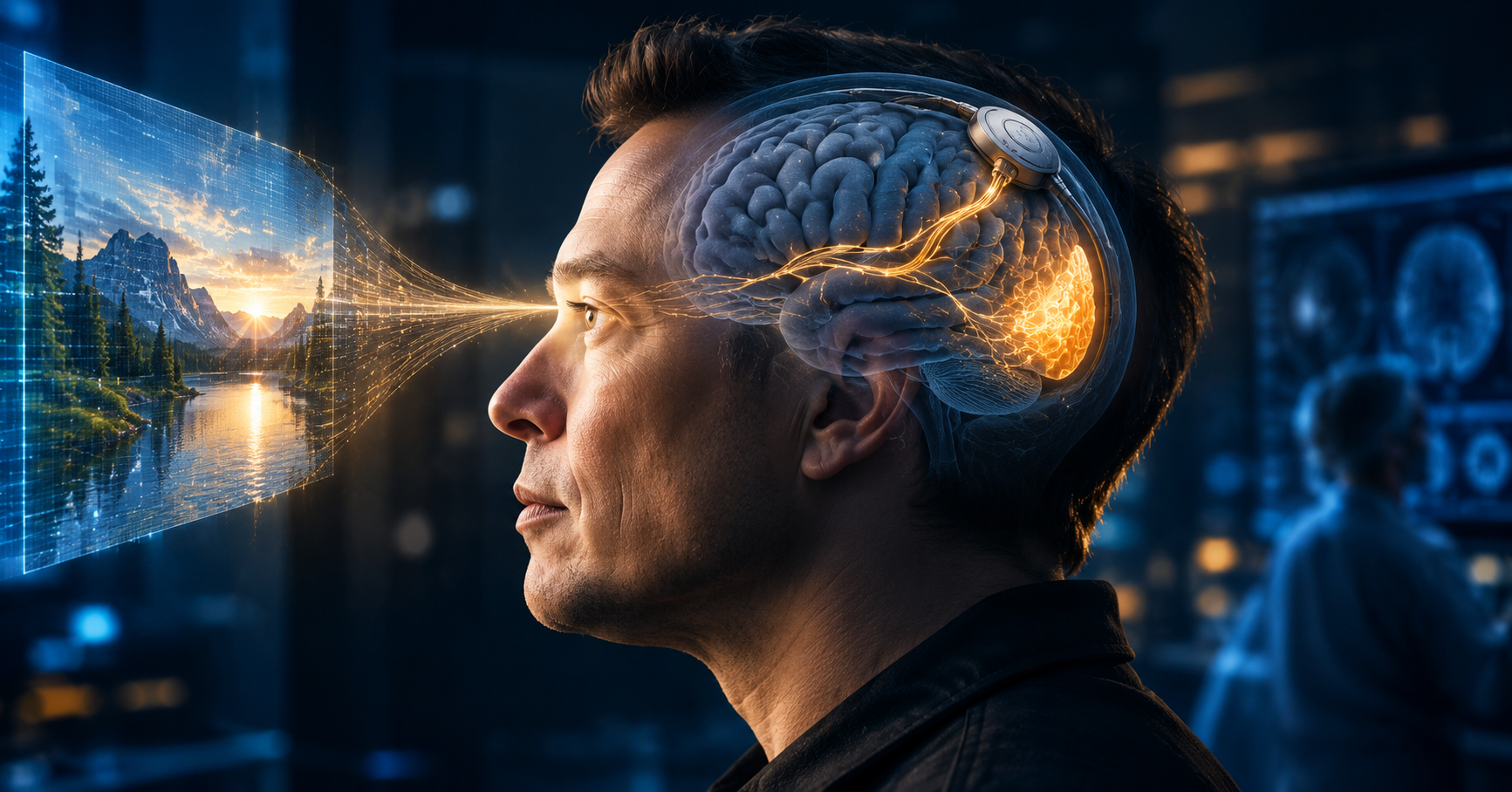
Elon Musk Says Neuralink Could Implant Its First Blindsight Vision Devices Within 6–12 Months: Can the Brain Restore Sight?
Imagine being able to see without using your eyes.
For millions of people living with severe visual impairment, that idea sounds almost impossible. Yet it is precisely the challenge Elon Musk's brain-technology company, Neuralink, is attempting to address with an experimental device called Blindsight.
In a recent statement shared by Coin Bureau, Musk reportedly said that Neuralink could implant its first vision devices within the next six to twelve months. He described a technology designed to send signals directly to the brain's visual cortex, potentially allowing people who cannot see to experience artificial vision.
The concept is striking because it approaches blindness from a different direction. Instead of attempting to repair damaged eyes or restore a damaged optic nerve, Blindsight is designed to communicate with the part of the brain responsible for processing visual information.
But there is a significant difference between stimulating the brain and restoring useful sight.
Neuralink has received the US Food and Drug Administration's Breakthrough Device Designation for Blindsight, an important regulatory milestone. However, the designation is not approval for general use, and the device has not yet publicly demonstrated restored vision in human patients.
So, what exactly is Neuralink building? Could a brain implant help someone who has been blind since birth see for the first time? And are Musk's predictions about infrared vision and enhanced human perception scientifically achievable?
Here is what the technology could mean, what researchers still need to prove, and why the distinction between scientific possibility and demonstrated results matters.
What Is Neuralink's Blindsight?
Blindsight is an experimental brain-computer interface designed to investigate whether electrical stimulation of the brain's visual cortex can produce visual perceptions in people with severe vision loss.
Neuralink is developing implantable technology that connects computer systems with neural activity. Its existing research has focused on allowing people with severe physical disabilities to control external devices using signals recorded from the brain.
Blindsight applies the broader brain-computer interface concept to a different problem: vision restoration.
Ordinary human vision involves several interconnected biological systems. Light enters the eye, the retina converts it into electrical signals, and the optic nerve carries those signals toward the brain. The brain then processes the incoming information into the visual experience people use to recognise faces, read words, navigate streets and understand their surroundings.
Damage to different parts of this system can cause blindness.
Traditional treatments may help when the underlying condition is treatable, but some people have damage that cannot currently be repaired through existing medical approaches.
Blindsight explores whether researchers can bypass certain damaged components and deliver information directly to the brain's visual processing system.
The potential significance is considerable. If the technology works safely and produces useful visual perception, it could eventually offer another research pathway for people whose blindness cannot be addressed by conventional treatments.
However, the outcome will depend on the nature of each person's visual impairment, the condition of their brain and the effectiveness of the implant.
How Could Neuralink Help Someone See Without Their Eyes?
The simplest way to understand Blindsight is to think of the visual system as a communication pathway.
In natural vision, information travels from the eyes through the optic nerves to the brain. If the pathway is damaged, the brain may no longer receive the signals needed to construct a visual experience.
A cortical visual prosthesis attempts to create an alternative route.
Step 1: An Implant Communicates With the Brain
The proposed system uses an implanted neural interface to stimulate neurons associated with visual processing.
Rather than depending entirely on signals arriving through the eyes, the device aims to deliver electrical stimulation directly to the visual cortex.
The visual cortex is located at the back of the brain and plays a central role in processing information related to sight.
Step 2: Electrical Stimulation May Produce Visual Perceptions
The goal is to stimulate selected areas of the visual cortex in patterns that the brain can interpret as visual information.
In principle, different stimulation patterns could produce different visual sensations, sometimes described as artificial points of light or phosphenes.
These sensations are not equivalent to normal vision.
A person perceiving isolated points of light may still struggle to identify objects, recognise faces, read text or understand complex surroundings.
Researchers therefore face a difficult problem: creating stimulation patterns that produce useful and interpretable visual information rather than disconnected sensations.
Step 3: The Brain Must Learn to Interpret the Signals
Even if a device successfully stimulates the visual cortex, the brain must be able to interpret the resulting information.
This is one of the most challenging aspects of artificial vision.
The human visual system processes enormous amounts of information about shape, movement, depth, colour, contrast and spatial relationships. Reproducing enough of that information through an implant is considerably more complicated than simply making the brain respond to electrical stimulation.
The quality of artificial vision would depend on several factors, including electrode placement, stimulation patterns, neural responses, device performance and the user's ability to adapt.
Neuralink has not publicly demonstrated that Blindsight can reproduce normal human vision in people.
The central scientific challenge is not simply sending electrical signals to the brain. It is teaching the brain to extract useful visual information from those signals.
Could Blindsight Help People Who Have Been Blind Since Birth?
One of Musk's most ambitious claims is that the technology could eventually help people who have never experienced sight.
This possibility raises a fundamental neuroscience question: can the brain develop a useful visual experience when the normal visual system has never provided it with sight?
The answer is complicated.
The brain has considerable capacity to adapt and reorganise itself. However, visual development involves biological processes that begin early in life, and the effects of congenital blindness can differ substantially depending on its cause and severity.
A person who becomes blind after previously seeing may retain visual memories and some of the neural pathways developed through earlier visual experience.
Someone born blind may have a different developmental history, and their ability to interpret artificially generated visual signals cannot simply be assumed to be the same.
A functioning visual cortex is important, but it is not sufficient evidence that an implant will restore useful sight.
Researchers would need to establish whether stimulation can produce repeatable perceptions, whether participants can learn to interpret them and whether those perceptions improve practical activities.
For example, detecting a light source is very different from recognising a familiar person across a room.
The ability to distinguish shapes is different from reading a street sign.
And experiencing visual sensations is different from navigating an unfamiliar environment independently.
These distinctions will matter when assessing any future clinical results.
Blindsight could open a new avenue of research for people who have been blind since birth, but the effectiveness of the approach remains an open scientific question.
What Does the FDA Breakthrough Device Designation Actually Mean?
Neuralink announced on September 17, 2024, that Blindsight had received the US Food and Drug Administration's Breakthrough Device Designation.
The designation is significant because it provides a regulatory pathway intended to facilitate the development and review of certain medical devices designed to address serious conditions.
Under the FDA's Breakthrough Devices Program, eligible developers can receive opportunities to interact with agency experts and obtain prioritised review of relevant regulatory submissions.
However, there is an important distinction between receiving the designation and obtaining permission to market a device for general use.
The designation does not establish that a device has been proven safe and effective. Nor does it mean that a treatment has successfully restored vision in patients.
A device still needs to satisfy the applicable regulatory requirements before it can be authorised for its intended commercial use.
For Blindsight, that distinction is especially important because the technology involves implanting a device in the brain and electrically stimulating neural tissue.
Researchers must evaluate potential surgical complications, device reliability, stimulation safety, long-term performance and whether the technology provides meaningful benefits.
The ultimate question is not whether the device has received an encouraging regulatory designation. It is whether properly conducted studies demonstrate that the implant can safely produce useful visual perception.
Is Neuralink Really Planning Its First Blindsight Implant Within 6–12 Months?
Musk reportedly gave a six-to-twelve-month timeline for the first Blindsight vision-device implants in the statement shared by Coin Bureau.
That claim has attracted attention because it suggests that the project could move closer to testing its central idea in human patients.
However, the timeline needs to be treated carefully.
Neuralink's public announcement of the FDA Breakthrough Device Designation dates to September 2024. Its publicly available clinical-trial information has described its Blindsight vision-restoration study as upcoming, while its established human studies have focused on other applications of brain-computer interfaces.
The public information available does not establish that the reported six-to-twelve-month window is a confirmed schedule for the first Blindsight implantation.
Several milestones would matter before a human study could demonstrate whether the technology works.
These include the relevant regulatory authorisations, the final study protocol, participant selection, surgical planning, device testing and safety monitoring.
Even if a first implantation occurs within the stated period, that would represent an early research milestone rather than proof that the device can restore useful vision.
Clinical studies take time because researchers need to understand not only whether a device produces an immediate response but also whether its effects are consistent, safe and meaningful over time.
For that reason, the reported timeline should be understood as Musk's projection, not a guaranteed launch date or a promise that patients will soon have access to the technology.
Could Neuralink Eventually Enable Infrared or Ultraviolet Vision?
Musk has also discussed a more futuristic possibility: using brain-computer interfaces to give people access to forms of visual information beyond the ordinary human range.
Humans can naturally see only a limited portion of the electromagnetic spectrum, known as visible light.
Infrared and ultraviolet radiation fall outside that range. Radar systems use electromagnetic waves at frequencies that are also not visible to human eyes.
A future technology could, in principle, collect information from sensors that detect these signals and translate that information into patterns the brain can learn to interpret.
For example, an infrared sensor could measure heat-related radiation and convert the resulting data into a visual representation.
A system could potentially encode that representation into patterns of neural stimulation, allowing a user to learn to distinguish features that would otherwise be invisible to ordinary sight.
However, this would not mean the brain was naturally seeing infrared or radar waves in the same way it processes visible light.
It would mean that an artificial system was translating information from another part of the electromagnetic spectrum into a form the brain could potentially interpret.
That distinction is crucial.
The underlying concept of sensory substitution is scientifically plausible, but Neuralink has not demonstrated that Blindsight can give people infrared vision, ultraviolet vision or radar perception.
Those possibilities remain speculative long-term ambitions rather than established capabilities of the device.
What Are the Biggest Risks and Challenges?
A technology that involves implanting electrodes in the brain must overcome several challenges before it can become a practical medical treatment.
1. Brain Surgery and Implant Safety
Implantation involves neurosurgical procedures, which carry risks that must be carefully evaluated.
Potential concerns include bleeding, infection, tissue injury and complications associated with the implanted hardware.
Researchers must also establish how the device behaves over time and whether its performance remains reliable.
2. Producing Useful Visual Information
Generating a visual sensation does not necessarily provide enough information to help someone function independently.
The system must eventually demonstrate that the signals it produces can be interpreted in ways that are meaningful for everyday activities.
This could require substantial advances in stimulation technology, signal processing and the understanding of how the visual cortex represents information.
3. Long-Term Reliability
An implanted device intended for long-term use must operate reliably over extended periods.
Researchers need to understand how electrode performance, neural responses and the surrounding tissue may change over time.
They must also consider device maintenance, potential replacement procedures and how complications would be managed.
4. Different Causes of Blindness
Blindness is not a single medical condition with one underlying cause.
Some people have damage to the retina, others have optic nerve damage, and others have conditions affecting the brain's visual pathways.
The suitability of a cortical implant may depend on which parts of the visual system remain functional.
A treatment that helps one group of patients may not produce the same results in another.
5. Cost, Accessibility and Clinical Evidence
Even if the technology eventually demonstrates meaningful benefits, access will depend on regulatory approval, medical infrastructure, cost and the availability of trained specialists.
Researchers and healthcare providers will also need evidence showing whether the benefits justify the surgical risks.
These challenges do not make the technology impossible. They explain why promising laboratory concepts must undergo careful testing before being treated as established medical solutions.
How Does Blindsight Compare With Neuralink's Existing Brain Implant?
Neuralink's existing human research provides useful context, but its different devices should not be confused.
The company's N1 implant, used in its Telepathy programme, is designed to record neural activity and allow eligible participants with severe physical disabilities to control external devices.
Participants can learn to use brain signals to move a computer cursor and interact with digital applications.
Blindsight has a different objective.
Rather than primarily recording signals so a computer can interpret a user's intended movements, the vision-restoration concept aims to stimulate the brain's visual cortex to produce visual perceptions.
The two applications illustrate different directions in brain-computer interface research.
One seeks to translate neural activity into commands that control external devices. The other seeks to deliver signals to neural tissue in an attempt to restore a sensory experience.
Success with a device-control implant does not automatically establish that a vision-restoration implant will work.
The relevant brain regions, technical requirements, safety considerations and measures of clinical success differ.
Blindsight must therefore be assessed on its own scientific evidence rather than on the progress of Neuralink's other projects.
What Could Successful Vision Restoration Mean for the Future?
If Blindsight or a similar technology eventually demonstrates safe and useful artificial vision, the implications could extend beyond the treatment of blindness.
A successful visual prosthesis could potentially help researchers better understand how the brain processes sensory information and how artificial signals can be integrated into neural systems.
It could also contribute to the broader field of neuroprosthetics, in which devices aim to restore or support functions affected by injury or disease.
However, the most meaningful early success would not be giving users extraordinary abilities.
It would be providing a measurable improvement in quality of life.
That might involve helping a participant detect objects, distinguish basic shapes, identify obstacles or perform specific tasks more effectively than before.
Such outcomes could be valuable even if the resulting visual experience remained far from natural sight.
For people living with severe blindness, a technology that provides a limited but genuinely useful visual capability could represent an important advance.
The extent of that benefit would need to be established through clinical research and through the experiences of people participating in the studies.
It is also important to recognise that assistive technologies, accessibility tools and existing treatments remain essential. An experimental brain implant should not be presented as a replacement for established care or as a guaranteed future cure.
Final Verdict: Can Elon Musk's Neuralink Help Blind People See?
Neuralink's Blindsight project is exploring a compelling scientific idea: delivering information directly to the brain's visual cortex may offer a route to artificial vision for some people whose sight cannot be restored through conventional treatments.
The concept is ambitious because it attempts to bypass damaged parts of the visual pathway rather than relying entirely on repairing them.
The FDA's Breakthrough Device Designation represents an important development milestone, but it is not proof that Blindsight can restore sight. The reported six-to-twelve-month implantation timeline also remains a projection unless confirmed through an official clinical announcement.
Questions about surgical safety, neural stimulation, visual perception and long-term effectiveness still need to be answered.
The same caution applies to predictions about infrared, ultraviolet and radar perception. Translating information from sensors into neural stimulation is a possible research direction, but Neuralink has not demonstrated those capabilities in humans.
For now, the most important milestone will be credible clinical evidence showing what participants can actually perceive and whether that perception improves their lives.
Blindsight could become an important chapter in the history of brain-computer interfaces. But the path from an ambitious vision to a safe, effective medical treatment will depend on what science can demonstrate, not just what technology leaders predict.
Frequently Asked Questions
What is Neuralink Blindsight?
Blindsight is an experimental Neuralink brain implant designed to investigate whether direct electrical stimulation of the visual cortex can produce visual perceptions in people with severe vision impairment.
Can Neuralink restore sight to someone who was born blind?
It is a possibility being investigated, but it has not been demonstrated by Neuralink in human patients. Outcomes may depend on the cause of blindness, the condition of the visual cortex and the brain's ability to interpret artificial visual signals.
When will Neuralink implant its first Blindsight device?
Musk reportedly suggested a six-to-twelve-month timeline. However, the publicly available information cited in this article does not establish a confirmed implantation schedule. An official clinical announcement would be needed to verify the timing.
Has the FDA approved Neuralink Blindsight?
Neuralink announced that Blindsight received FDA Breakthrough Device Designation in September 2024. This designation is not the same as approval for general medical use and does not establish that the device is safe and effective.
How does Blindsight work without relying on the eyes?
The experimental approach aims to stimulate the visual cortex directly, bypassing certain damaged components of the normal visual pathway. Researchers must establish whether the stimulation produces repeatable, useful visual perceptions.
Will Neuralink allow humans to see infrared or ultraviolet light?
Musk has discussed that possibility as a future ambition. However, Neuralink has not demonstrated infrared or ultraviolet vision through Blindsight in humans. Such a system would need to translate information from sensors into patterns the brain could learn to interpret.
Is Neuralink's existing Telepathy implant the same as Blindsight?
No. Telepathy is designed to help eligible participants control external devices through brain signals. Blindsight is intended to investigate whether stimulation of the visual cortex can produce artificial vision.
What are the risks of a brain implant designed to restore vision?
Potential risks include complications from brain surgery, infection, tissue injury, device malfunction and uncertain long-term performance. The effectiveness and safety of the specific Blindsight system must be established through appropriate clinical research.
Sources and Further Reading
- Neuralink's official announcement on the Blindsight FDA Breakthrough Device Designation, September 17, 2024.
- US Food and Drug Administration: Breakthrough Devices Program.
- Neuralink's official clinical trials information.
- Reuters' reporting on Neuralink's Blindsight designation and the company's vision-restoration ambitions.
- IEEE Spectrum's technical analysis of the scientific challenges involved in artificial vision.
Editorial disclaimer: This article explains an experimental technology and its potential applications. It is not medical advice. Blindsight remains investigational, and its safety and effectiveness for restoring human vision have not been established.