
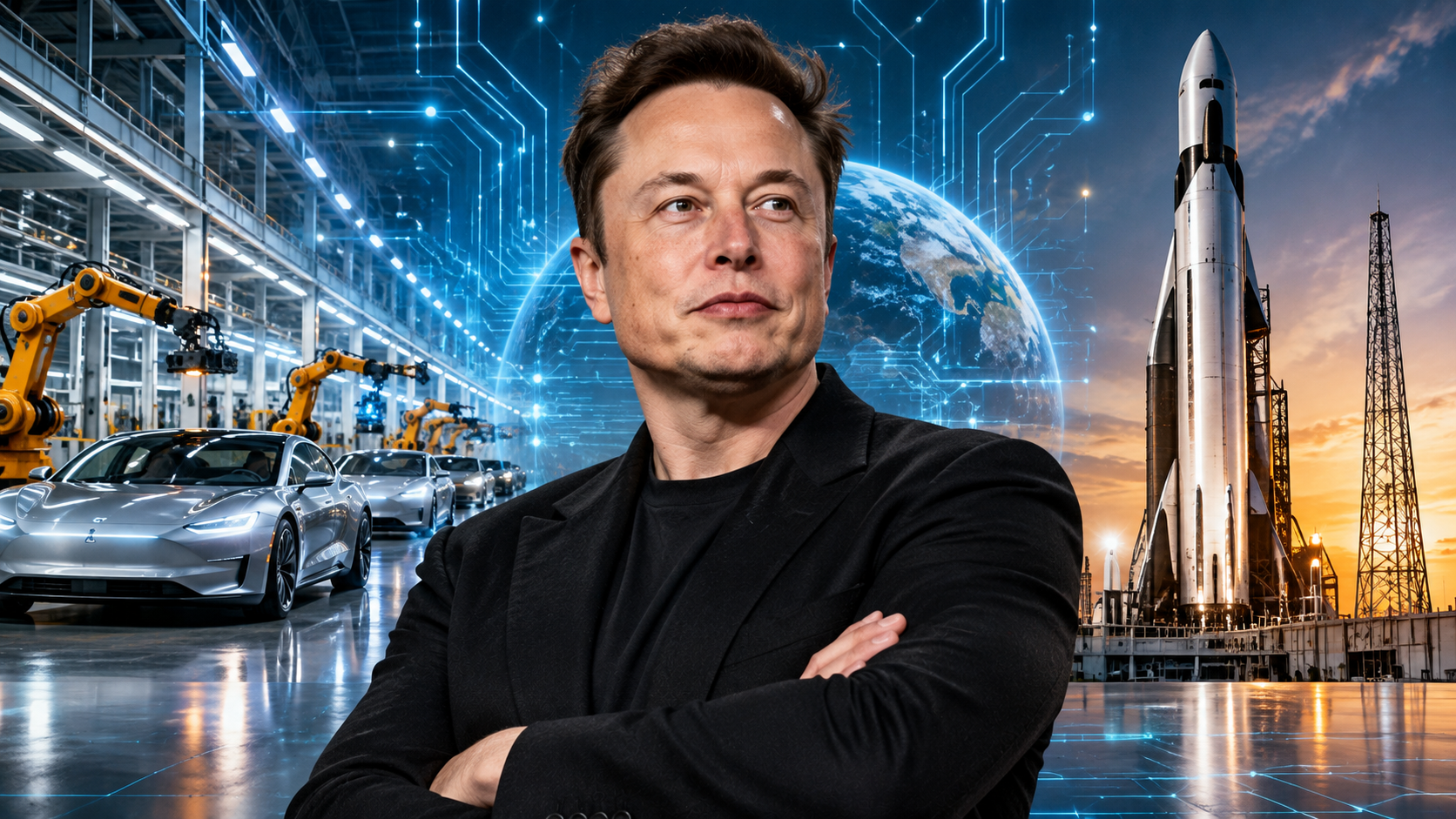
Elon Musk's $3.4 Trillion Mega-Merger Could Change the Business World Forever
Elon Musk may be preparing for one of the biggest corporate moves of his career.
The billionaire entrepreneur is reportedly moving closer to combining two of his most valuable businesses, potentially bringing his electric vehicle, aerospace and artificial intelligence ambitions under a single corporate structure.
According to a November 12 report from Bloomberg, cited by Reuters, merger negotiations between Tesla and SpaceX are progressing. An announcement could come as early as December, although discussions have also considered a possible delay until early 2027.
The potential scale is extraordinary.
At their previous market valuations, SpaceX was worth approximately $1.90 trillion, while Tesla had a market value of around $1.55 trillion. Together, that represents approximately $3.45 trillion.
But this is about more than combining two large companies. It could bring together technologies that Musk believes will play a central role in the next generation of computing, transportation and space exploration.
Elon Musk Has Already Said a Merger Makes Sense
The latest reports are not based entirely on speculation.
During SpaceX's third-quarter earnings call in October, Musk publicly acknowledged that combining the two businesses could be a good idea.
He also confirmed that both companies had established special committees of independent directors to examine a potential transaction.
Musk explained that he could not participate directly in the committees' discussions because of his conflicting interests.
That detail is important. Any proposed deal would need to be evaluated through an independent process, with shareholder interests and corporate governance taken into account.
Musk also cautioned investors against assuming that a merger was inevitable. At the time, the committees had not agreed on transaction terms, and he acknowledged that discussions might not result in a deal.
The latest reports suggest negotiations have progressed, but no definitive merger agreement has been publicly announced.
Why Would Musk Combine Two Very Different Businesses?
At first glance, an electric vehicle manufacturer and a rocket company may seem like unusual merger partners.
However, Musk's long-term ambitions increasingly connect several areas of technology.
Artificial intelligence, autonomous machines, advanced chips, satellite communications and space-based infrastructure are becoming interconnected parts of his business strategy.
A combined corporate structure could potentially make it easier to coordinate investment and development across these areas.
Here are four reasons the idea is attracting attention.
1. Artificial Intelligence Could Become the Biggest Connection
AI is one of the strongest links between Musk's businesses.
Tesla develops autonomous driving systems and humanoid robots, while SpaceX has been expanding its computing infrastructure and AI-related activities.
Bringing the companies closer together could create opportunities to coordinate computing resources, software development and infrastructure investment.
However, the precise financial and operational benefits of a merger remain uncertain.
2. Robotics Could Become a Much Bigger Business
Tesla's Optimus humanoid robot programme is another important part of Musk's strategy.
The company is working toward developing robots capable of performing repetitive and physically demanding tasks.
SpaceX, meanwhile, operates in an environment where advanced automation, engineering and robotics are essential.
A closer relationship between the businesses could create opportunities for sharing expertise and manufacturing capabilities.
3. Satellite Internet Could Connect More Than Just Homes
SpaceX's Starlink network has already become a major player in global satellite internet.
Its connectivity infrastructure could potentially create opportunities for connected transportation, remote operations and other technology services.
Tesla's vehicles and future autonomous systems could benefit from stronger connectivity, although a merger would not automatically create new products or services.
4. Advanced Chips Could Be a Major Strategic Advantage
Musk has also discussed Terafab, a semiconductor manufacturing joint venture involving Tesla, SpaceX and xAI.
During the October earnings call, he said the project expected to produce its first test chip around May or June 2027, with volume production targeted for the third quarter of 2028.
The project highlights how important semiconductor production has become to Musk's broader technology ambitions.
If the merger moves forward, chip development could become an even more closely coordinated part of the combined strategy.
The $3.45 Trillion Valuation: What the Numbers Really Mean
The headline figure is likely to attract considerable attention, but there is an important distinction.
The approximately $3.45 trillion figure comes from adding the reported market values of the two companies at their previous market close.
It is not a confirmed merger price, an agreed acquisition valuation or the value of a signed transaction.
The final structure could look very different.
A deal might involve a stock exchange, an acquisition or another corporate arrangement. Each possibility would affect existing shareholders differently.
For Tesla investors, the key question will be how much ownership they retain in a combined business and what financial terms the independent committees ultimately recommend.
Until those details are released, the $3.45 trillion figure should be treated as an estimate based on separate company valuations.
Why the Merger Could Face Serious Regulatory Challenges
Even if Musk's companies reach an agreement, completing the transaction may be difficult.
SpaceX has important contracts with the US government and operates in sensitive aerospace and defence-related areas.
Tesla, meanwhile, has significant manufacturing and business operations in China.
Bringing the two businesses under common ownership could raise questions about national security, sensitive technology, data management and regulatory oversight.
US authorities and other relevant regulators could examine how a combined company would handle these issues.
The transaction could also attract scrutiny over conflicts of interest because Musk leads both businesses and holds substantial ownership stakes in them.
Independent board committees and shareholder approval will therefore be crucial.
What Could Happen to Elon Musk's Business Empire?
A successful merger would represent a major shift in how Musk's businesses are organised.
Instead of operating as separate corporate giants, their technologies and long-term investment plans could become more closely aligned.
The potential combination would connect several industries:
- Electric vehicles and autonomous transportation.
- Rocket launches and space infrastructure.
- Satellite internet and global connectivity.
- Artificial intelligence and advanced computing.
- Humanoid robotics and semiconductor development.
Few corporate combinations would bring together such a wide range of strategically important technologies.
However, greater scale does not automatically mean greater efficiency. Managing businesses with different customers, financial requirements and regulatory obligations could become a significant challenge.
December Could Be a Defining Moment
The latest reporting has put December 2026 in focus as a possible announcement window.
But the timeline is not guaranteed. The companies have also discussed a scenario in which an announcement moves into early 2027.
The independent committees must continue evaluating the proposal, and shareholders would ultimately have an important role in approving any transaction.
For now, investors have more questions than answers.
Will the companies agree on a structure? How would shareholders be compensated? Could regulators approve such a powerful combination? And would bringing these businesses together actually accelerate Musk's technology ambitions?
Those questions will matter far more than the headline valuation.
Elon Musk has spent decades building companies that challenge established industries. A merger of this scale could be his most ambitious corporate move yet — but turning the idea into a completed deal may prove just as difficult as building the businesses themselves.
The Bottom Line
Elon Musk is reportedly moving closer to merging Tesla and SpaceX into a single corporate empire.
If completed, the deal could be worth approximately $3.45 trillion — uniting electric vehicles, rockets, AI, robotics and satellite internet.
But this is still a negotiation, not a signed deal. Independent committees, shareholders and regulators all stand in the way.
The $3.45 trillion figure is an estimate, not a confirmed transaction price.
December could be a defining moment — or the deal could slip into 2027.
For now, the business world is watching the biggest potential merger in modern history take shape.
About CoinAINews
CoinAINews Editorial Team covers cryptocurrency regulation, blockchain technology, digital asset markets, traditional finance, and developments shaping the global tech industry.
Disclaimer: This article is for informational purposes only and does not constitute financial or investment advice. The proposed merger remains under discussion. No definitive binding agreement has been publicly announced. The approximately $3.45 trillion figure represents the combined reported market valuations of the two companies, not an agreed transaction value.