
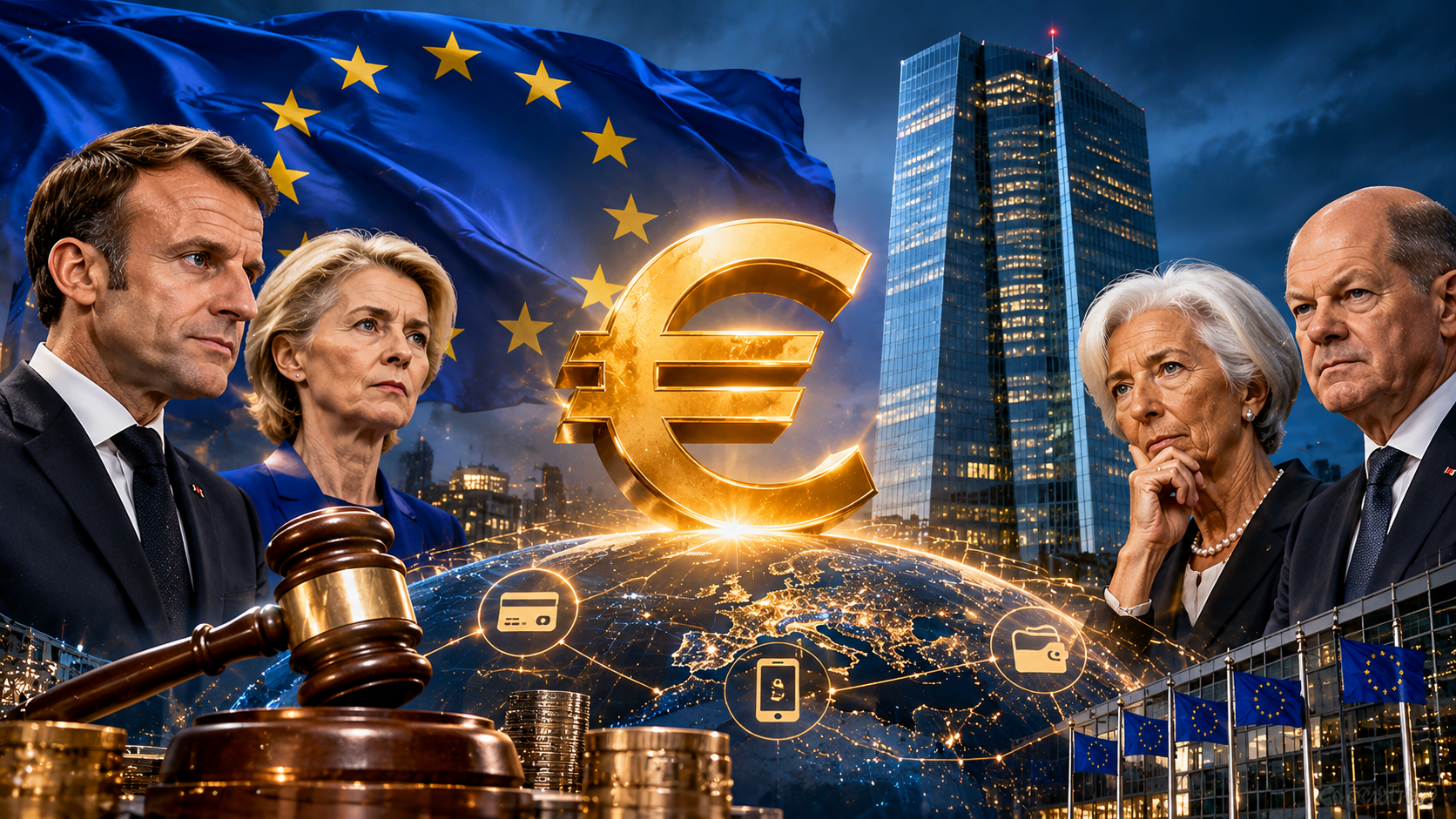
Europe's Digital Euro Hits a Roadblock — A Fight Over Sanctions Could Change Everything
Europe's plan to introduce its own digital currency has hit a political roadblock. And the disagreement is raising a question that goes far beyond payments: who should have the power to decide who gets access to money?
The issue emerged during negotiations between the European Parliament, the European Commission and the Council of the European Union. After around 14 hours of discussions, the three institutions failed to reach an agreement on an important part of the proposed digital euro rules.
At the centre of the dispute is international sanctions.
According to Cinco Días, European lawmakers disagree over whether individuals affected by sanctions imposed by countries outside the EU should still be able to access the digital euro when those restrictions are not recognised by the European Union.
The next round of negotiations is expected on December 3, 2026.
Why Has the Digital Euro Become a Political Issue?
The disagreement is not simply about payment technology.
The European Parliament wants stronger guarantees that people affected by foreign sanctions can access the digital euro. The Council, meanwhile, is concerned that financial institutions could face pressure or consequences for providing services to such individuals.
This creates a difficult situation for Europe.
The EU wants greater control over its financial infrastructure, but foreign sanctions can still influence how international banks and payment providers operate.
The digital euro could become an important part of Europe's response to that dependence. However, the current disagreement shows that creating a new payment system does not automatically solve the political challenges surrounding money.
Europe Wants an Alternative to Foreign Payment Networks
The European Central Bank (ECB) is developing the digital euro as an electronic version of central bank money.
Unlike Bitcoin or privately issued stablecoins, it would be backed by the Eurosystem.
The goal is to give people another way to pay for everyday purchases, transfer money and make online payments without depending entirely on existing private payment providers.
Europe is particularly interested in reducing its reliance on international payment infrastructure dominated by companies such as Visa and Mastercard.
The digital euro is not designed to replace cash. It is intended to work alongside physical money, bank deposits and existing payment services.
The proposed system is also expected to support online and offline payments, although its final features will depend on the legislation.
Could This Be a Challenge for USDT and USDC?
The development is worth watching for the cryptocurrency industry.
Stablecoins such as USDT and USDC have become important tools for digital asset trading and international transfers. Their popularity comes from the ability to move dollar-linked value across digital platforms without relying on traditional bank transfers for every transaction.
A digital euro would introduce a different option: digital money issued by a central banking system rather than a private company.
If adoption grows, it could eventually compete with private euro-denominated stablecoins in certain payment activities.
However, it would be wrong to assume that the digital euro will replace USDT, USDC or Bitcoin. Each serves a different purpose, and dollar-based stablecoins have a much broader international role.
For now, the digital euro is primarily a European payment project rather than a direct competitor to the entire cryptocurrency market.
Spain's Pablo Hernández de Cos Set to Lead the ECB
Another important development came on November 26, when European leaders put forward Spanish economist Pablo Hernández de Cos as the next president of the European Central Bank.
He is expected to succeed Christine Lagarde, subject to the remaining formal appointment process. His proposed eight-year term is scheduled to begin in February 2027.
Hernández de Cos previously served as governor of the Bank of Spain and currently leads the Bank for International Settlements.
His arrival could be significant as Europe enters a crucial period for digital payments and financial innovation.
However, the current digital euro negotiations are a separate legislative issue, and there is no indication that his selection caused the disagreement.
When Could the Digital Euro Actually Launch?
The digital euro is not yet available to the public.
The ECB is preparing for a possible 12-month pilot starting in the second half of 2027. If the required legislation is approved and preparations proceed as planned, the first issuance could take place in 2029.
That timeline is not guaranteed.
The December 3 negotiations will therefore be worth watching. European institutions need to resolve the remaining political questions before the project can move towards actual issuance.
Europe wants a digital currency that gives it greater control over its financial future. But the latest disagreement reveals the real challenge: building a payment system is one thing; deciding who can use it, and under whose rules, is another.
The Bottom Line
The digital euro has hit a political roadblock over international sanctions.
EU institutions failed to reach an agreement after 14 hours of negotiations, with the next round scheduled for December 3, 2026.
The European Parliament wants sanctions-affected individuals to access the digital euro, while the Council worries about consequences for financial institutions.
Pablo Hernández de Cos has been nominated as the next ECB president, starting February 2027.
The digital euro pilot is planned for 2027, with first issuance potentially in 2029 — if the political deadlock is resolved.
About CoinAINews
CoinAINews Editorial Team covers cryptocurrency regulation, blockchain technology, digital asset markets, traditional finance, and developments shaping the global tech industry.
Disclaimer: This article is for informational purposes only and does not constitute financial or investment advice.
Sources
- Cinco Días – Digital Euro Negotiations and International Sanctions
- European Central Bank – Digital Euro
- European Central Bank – Digital Euro FAQs
- European Council – Official Updates
- Reuters – European Central Bank Leadership