
Moonshot AI Launches Kimi K3.1 Pro: 2.8 Trillion Parameters, 1M Context Window and a Challenge to GPT-6 Astra
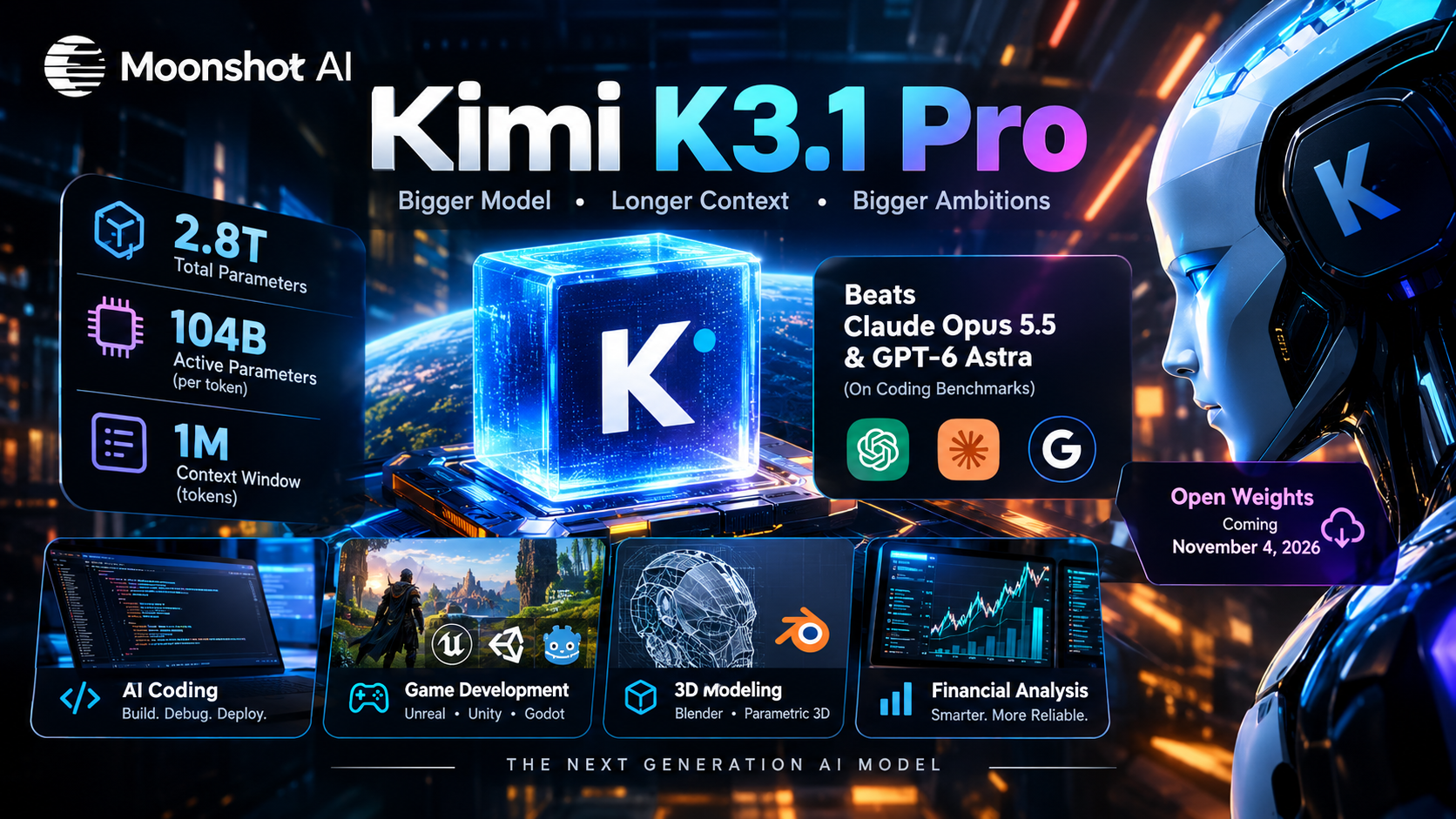
Moonshot AI has introduced Kimi K3.1 Pro, a large-scale AI model built for long-running coding tasks, autonomous agents, 3D creation and financial workflows. The company claims a 2.8-trillion-parameter architecture with 104 billion active parameters per token and a one-million-token context window. Full model weights are promised by November 4, 2026, while independent testing will determine how its reported benchmark results translate into practical performance.
The competition to build more capable AI systems is moving beyond chatbots that answer questions or generate short pieces of code. Developers increasingly want models that can understand large projects, use tools, navigate complicated workflows and keep working toward a goal over multiple steps.
Moonshot AI's new Kimi K3.1 Pro is designed for that shift.
The Chinese AI company says its latest model delivers improvements in coding, agentic tasks, 3D modeling and financial research. It has also introduced Kimi K3.1 Pro Highspeed, a faster variant that the company says runs two to three times faster than the standard version.
The announcement puts Kimi back into the conversation around powerful AI models that may eventually be available for developers to run and adapt themselves. However, there is an important distinction between what Moonshot has announced and what independent users have verified: the headline benchmark results are largely company-reported, and the promised downloadable weights were not yet available in the reports published on October 24.
What Is Kimi K3.1 Pro?
Kimi K3.1 Pro is the first model in Moonshot AI's new K3.1 series. According to the company, it builds on Kimi K3 with substantially more post-training compute and improvements to reinforcement learning, long-context processing and training efficiency.
Moonshot describes it as its most capable model in the three-trillion-parameter class to date.
The model is intended for more than conventional question-and-answer interactions. Its target applications include software development across large codebases, multi-step AI agents, parametric 3D modeling, financial analysis and workflows that require a model to use tools and complete a sequence of tasks.
That focus reflects a broader shift in AI development. Instead of judging a system only by how convincingly it responds to a prompt, developers increasingly need to know whether it can carry out a task, handle errors and produce a usable result.
Kimi K3.1 Pro's capabilities are promising on paper. How consistently it delivers on those ambitions will depend on testing across real projects, different tools and a range of workloads.
Inside the Architecture: 2.8 Trillion Parameters, 104 Billion Active
One of the most striking specifications attributed to Kimi K3.1 Pro is its reported 2.8-trillion total parameters, with approximately 104 billion active per token.
The figures describe a mixture-of-experts, or MoE, architecture. Rather than activating every parameter for every token, an MoE model routes work through selected parts of its network.
This approach can let a model have a very large total parameter count without using all of those parameters for every individual token. It is one way developers seek to balance model capacity with computational efficiency.
The distinction between total and active parameters matters. A 2.8-trillion-parameter model does not necessarily use 2.8 trillion parameters for each token it processes. Its runtime costs and hardware requirements depend on factors such as routing, precision, memory, implementation and the amount of computation used during inference.
Moonshot's model specifications have attracted attention because they combine a very large overall architecture with a comparatively smaller active parameter count. But parameter count alone does not determine whether a model is better at coding, reasoning or completing complex tasks.
Real-world performance, reliability, inference speed and operating costs remain essential parts of the comparison.
Why the One-Million-Token Context Window Matters
Kimi K3.1 Pro features a reported context window of up to one million tokens.
A context window determines how much information a model can process within a single interaction or task context. A larger window can be valuable when the work involves lengthy documents, extensive codebases, technical specifications or multiple connected sources.
For software engineers, this could mean providing a model with more files and project documentation without having to repeatedly split the work into smaller pieces.
For financial researchers, a large context could help bring together company filings, historical reports, assumptions and supporting data during an analysis workflow.
For AI agents, it may help preserve relevant information across a complicated task.
There is an important limitation, however: a large context window does not guarantee that every detail will be understood or used correctly. Models can overlook information, misinterpret instructions or produce inaccurate answers even when the relevant material fits within the available context.
The useful question is not simply how much information a model can accept, but how reliably it can retrieve, reason over and apply that information.
Coding Benchmarks: Does Kimi K3.1 Pro Beat GPT-6 Astra and Claude Opus 5.5?
Moonshot's reported benchmark results are a major part of the launch story.
The company's figures show Kimi K3.1 Pro performing competitively against proprietary models on selected coding and agent benchmarks. But the results do not establish that it is the best model across all tasks.
One example is Terminal-Bench 4.0, which evaluates AI agents on terminal-based tasks. Moonshot reports a score of 65.7% for Kimi K3.1 Pro, compared with 66.4% for Claude Opus 5.5 and 58.2% for GPT-6 Astra.
On those reported numbers, Kimi is ahead of GPT-6 Astra but remains slightly behind Claude Opus 5.5.
The company also reports a score of 61.2% on its internal Kimi Code Bench 3.0 Long-horizon evaluation, up from 55.95% for Kimi K3. This test is designed around multi-step execution, tool use and end-to-end problem-solving across engineering tasks.
These results suggest progress in the areas Moonshot is targeting. Yet internal evaluations and company-run comparisons need to be interpreted carefully, particularly when the model developer controls the test setup.
Independent reproduction, transparent scoring rules and consistent evaluation conditions are necessary to establish how meaningful the differences are.
Selected reported benchmark results
| Benchmark | Kimi K3.1 Pro | Claude Opus 5.5 | GPT-6 Astra |
|---|---|---|---|
| Terminal-Bench 4.0 | 65.7% | 66.4% | 58.2% |
| SWE Marathon v1.1 | 51.7 | 46.3 | 42.5 |
| OfficeQA Pro v2 | 64.4 | 62.2 | 54.4 |
| BrowseComp | 92.1 | 90.8 | 91.5 |
Figures are from Moonshot's published comparison as reported by On The Wire on October 24, 2026. Scores use each benchmark's reported scale and should not be compared across different benchmarks. The results are not a substitute for independent testing.
The table shows why a single headline can be misleading. Kimi leads on some reported evaluations, while Claude or GPT-6 Astra leads on others. Results also depend on reasoning settings, tool access, evaluation procedures and whether a benchmark is internal or independently maintained.
The fairest conclusion is that Moonshot is claiming strong performance across several areas—not that Kimi K3.1 Pro has conclusively surpassed every leading proprietary model.
From Writing Code to Building Complete Projects
Moonshot is positioning Kimi K3.1 Pro as a model capable of working on full projects rather than only producing isolated code snippets.
The company says the model can help create game projects using Unreal Engine, Unity and Godot. It also highlights parametric 3D modeling through tools such as Blender and computer-aided design workflows.
If these capabilities prove reliable outside controlled demonstrations, they could change how developers approach early-stage projects.
A developer might use an AI agent to create a basic game structure, implement gameplay mechanics, identify errors and refine a project over multiple iterations. A designer might use model-generated scripts to build or modify a parametric object. A small team could use an AI assistant to handle repetitive development work while people concentrate on architecture, creative decisions and testing.
But creating a project that opens is not the same as delivering a production-ready application. A working result still needs to be checked for bugs, performance, security, maintainability and compatibility with the relevant software.
Moonshot's claims therefore point to an important direction for AI-assisted development, while independent hands-on tests will be needed to establish the quality of the resulting projects.
Financial Modeling and the Claim of Fewer Hallucinations
Moonshot has also highlighted financial research and modeling as target use cases for Kimi K3.1 Pro.
Financial workflows can involve spreadsheets, assumptions, linked calculations, company reports and scenarios that depend on one another. A capable AI agent could help assemble a model, check formulas, summarize supporting evidence and test alternative assumptions.
The company has separately promoted improvements in financial-modeling reliability and a reduction in hallucinations on its own evaluation. Such claims should be treated as results from the specific tests described by Moonshot, not as proof that the model is consistently accurate in every financial setting.
A lower error rate on an internal benchmark does not mean that a model will never invent a figure, misread a filing or produce an incorrect formula. Users should verify calculations and trace important claims to original documents, especially when financial decisions depend on them.
For business users, the value of the model will ultimately depend on whether it can produce auditable work—not merely plausible-looking spreadsheets or confident explanations.
Open Weights Are Promised for November 4
One of the most consequential parts of the announcement is Moonshot's plan to release the full model weights by November 4, 2026.
The model is available through Kimi's services and API, but the downloadable weights had not yet been released in the reporting available on October 24.
Open weights could give researchers and developers greater flexibility to inspect, deploy and adapt the model, subject to the eventual licence and technical requirements.
Organisations may be interested in running models within their own infrastructure, integrating them into specialized tools or experimenting with workflows that are difficult to support through a hosted service alone.
However, a promise to publish weights is not the same as an already available, openly licensed model. Developers should wait for the actual release and review the licence, hardware requirements, inference software and usage restrictions before planning a deployment.
A model of this scale may also require substantial memory and computing resources. The active parameter count alone does not reveal how much hardware is needed to run the complete model effectively.
The November 4 date is therefore an important milestone for anyone waiting to test Kimi K3.1 Pro outside Moonshot's hosted products.
The Safety Question: Powerful Coding Models and Cybersecurity
The launch also raises questions about the risks associated with distributing capable AI models.
In a report published on October 24, Reuters said Moonshot had removed cyber-related data from training materials and reinforcement-learning environments to reduce the model's offensive cybersecurity capabilities before its planned weights release.
Moonshot reported that a version without those risk-reduction measures scored 90.5% on an internal controlled vulnerability-finding and exploitation benchmark, while the version prepared for release scored 81.0%.
Those results have not been independently verified, according to Reuters.
The figures illustrate a difficult trade-off for AI developers. Coding capabilities can help security teams identify bugs, audit software and improve defenses. The same capabilities may also be misused to find vulnerabilities or automate parts of an attack.
Once model weights are widely distributed, the original developer has less direct control over how the model is deployed than it would have with an entirely hosted service.
Moonshot says it wants to preserve useful coding performance without releasing weights that push offensive cyber capabilities to the frontier. Whether the safeguards work as intended will require further evaluation.
For businesses considering deployment, model quality is only one factor. Access controls, monitoring, secure tool permissions and human review remain important.
How to Access Kimi K3.1 Pro
According to Moonshot's launch information, Kimi K3.1 Pro and its Highspeed variant are available through the company's Kimi services, including Kimi.ai, Kimi Work, Kimi Code and the Kimi API.
The Highspeed version is described by Moonshot as running two to three times faster than the standard model. Actual response times can vary with workload, output length, service conditions and the tools being used.
Developers who want to evaluate the model should test it against their own tasks rather than relying only on headline benchmark scores. Useful tests include whether it can complete a multi-file coding change, recover from a failed command, use tools correctly and produce results that pass the project's tests.
For organisations planning to self-host, the key date is November 4, when Moonshot says the full weights are due. Their availability, licence terms and deployment requirements should be checked when the release arrives.
What Kimi K3.1 Pro Means for the AI Race
Kimi K3.1 Pro arrives at a time when competition is increasingly focused on agentic AI: systems that can use tools, complete sequences of actions and deliver results beyond a single response.
Moonshot's announcement brings several trends together—a very large MoE architecture, a million-token context window, an emphasis on long-running coding tasks and a promised open-weight release.
If independent testing confirms strong performance and the weights arrive under a usable licence, the model could become a meaningful option for developers who want to experiment with advanced coding and agent workflows.
But the announcement should not be reduced to a simple winner-versus-loser story. Benchmark performance varies by task, and a model that leads on one coding evaluation may lag on scientific reasoning, cybersecurity or another real-world workload.
The next phase will be more revealing than the launch itself. Developers will be watching for the weights, transparent evaluation results and hands-on demonstrations that show whether the model can deliver complete, reliable projects outside controlled tests.
For now, Kimi K3.1 Pro is a significant new release with ambitious claims. Its long-term standing will depend on evidence that goes beyond the specification sheet.
Frequently Asked Questions
1. What is Kimi K3.1 Pro?
Kimi K3.1 Pro is a reasoning-focused AI model released by China's Moonshot AI. The company targets coding, AI agents, 3D creation, financial research and long-context tasks.
2. How many parameters does Kimi K3.1 Pro have?
Reports based on Moonshot's specifications describe approximately 2.8 trillion total parameters and 104 billion active parameters per token in a mixture-of-experts architecture.
3. Does Kimi K3.1 Pro have a one-million-token context window?
Yes. Moonshot advertises a context window of up to one million tokens, allowing the model to process large amounts of information in a single context. This does not guarantee perfect recall or accuracy.
4. Is Kimi K3.1 Pro better than GPT-6 Astra or Claude Opus 5.5?
Moonshot's published benchmarks show Kimi ahead on some evaluations and behind on others. The available results do not establish that it is universally better than either model.
5. When will Kimi K3.1 Pro's open weights be released?
Moonshot has promised to release the full model weights by November 4, 2026. The weights and their final licence should be checked when the release becomes available.
6. Can Kimi K3.1 Pro build games?
Moonshot says the model can assist with full-project coding for Unreal Engine, Unity and Godot. Independent testing is needed to assess how reliably it can build, debug and deliver usable games.
7. Is Kimi K3.1 Pro free to run locally?
The full weights were not yet available in the reports cited here, so local deployment options and licence terms could not be confirmed. Running a model of this scale may also require substantial hardware.
8. Why is Kimi K3.1 Pro relevant to AI agents?
Its focus on long-horizon coding, tool use and multi-step workflows reflects the shift from AI that merely generates text to systems intended to complete tasks. Reliability on real projects remains the key test.
Sources
- Moonshot AI — Kimi K3.1 Pro launch announcement and technical information.
- Reuters — Reporting on Moonshot's cybersecurity safeguards and planned open-weight release, October 24, 2026.
- The Economic Times / ANI — Kimi K3.1 Pro launch details and company-reported benchmark results, October 24, 2026.
- On The Wire — Analysis of Moonshot's benchmark comparison and open-weight release status, October 24, 2026.
Disclaimer: This article is for informational purposes only. Model specifications and benchmark figures attributed to Moonshot are company-reported unless explicitly stated otherwise. Independent results, release details and licensing terms may change as more information becomes available.