
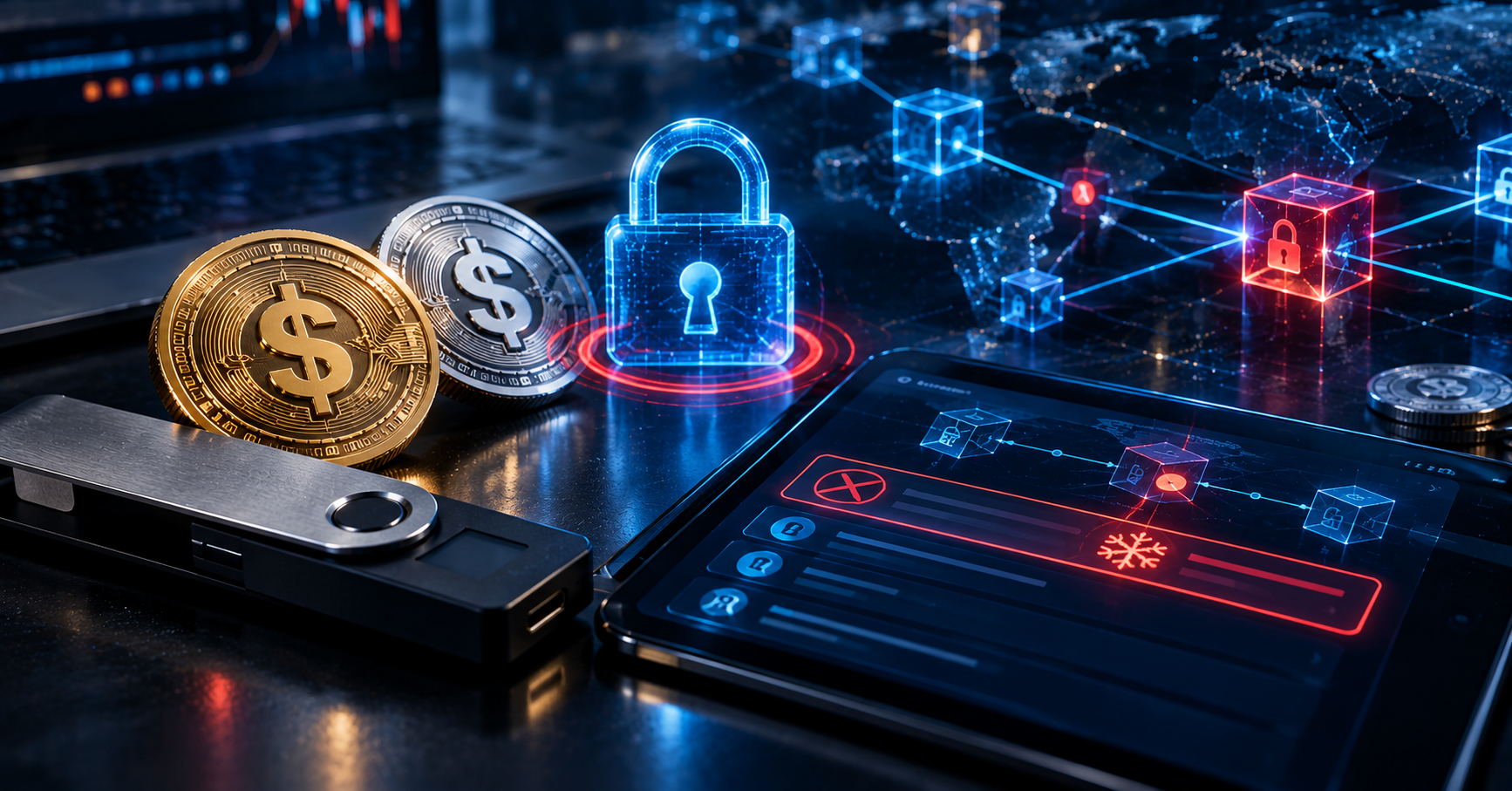
Your Crypto Wallet Can Be Yours, but Your Stablecoins Can Still Be Frozen
Owning your private keys is one of the most important principles in cryptocurrency. It means you can control your wallet without depending on a bank or an exchange to approve every transaction. But there is an important limitation that many crypto holders overlook: controlling a wallet does not always mean having unrestricted control over every token inside it.
Stablecoins such as Tether's USDT and Circle's USDC operate through smart contracts that can include issuer-controlled freezing mechanisms. If an address is blacklisted under the token's rules, its holder may still see the balance on a blockchain explorer or inside a wallet app, yet be unable to transfer those tokens.
The distinction matters as stablecoins become increasingly important for trading, international payments, decentralised finance (DeFi) and digital-dollar access. A wallet can remain operational while one particular asset becomes unusable.
The issue is not necessarily a weakness in the wallet itself. It reflects how some stablecoins are designed—and the balance their issuers attempt to strike between open blockchain transfers, regulatory obligations and the ability to respond to suspected financial crime.
How a Stablecoin Freeze Actually Works
A common misconception is that cryptocurrency sits inside a wallet in the same way cash sits inside a physical purse. In practice, a wallet generally stores or manages the keys needed to authorise transactions, while token balances are recorded by smart contracts on the blockchain.
A private key allows its holder to sign a transaction. However, the relevant token contract also applies its own rules before a transfer can complete.
For some centrally issued stablecoins, those rules include administrative controls that allow the issuer to restrict particular addresses. Circle's USDC contract, for example, includes address-blocking functionality. Tether also maintains blacklist controls for USDT.
When an address is blocked, a transfer involving the affected token may fail even when the transaction has been correctly signed. The holder has not necessarily lost the private key, and the wallet itself may not have been compromised. Instead, the token contract is refusing to process the transaction.
This is the central difference between wallet ownership and token-level transfer permission.
A freeze generally applies to the affected issuer's token, rather than automatically disabling every asset held at the same address. Other cryptocurrencies may remain transferable, depending on their own contracts and the circumstances involved.
The exact effects can vary by token and blockchain, so users should not assume that every stablecoin follows an identical technical or legal framework.
Why Would USDT or USDC Be Frozen?
Stablecoin issuers operate in a different environment from cryptocurrencies designed without a central issuing authority. Their products are intended to track the value of a currency, typically the US dollar, and their issuers may have legal, compliance and security responsibilities.
Those responsibilities can involve responding to sanctions, court orders, law-enforcement requests or suspected illicit activity. Issuers may also retain powers to respond to security incidents affecting their systems.
Circle's published policies describe circumstances in which it may restrict addresses. Tether has also publicly discussed cooperating with law-enforcement authorities to freeze suspected illicit funds.
The reasoning is straightforward from a compliance perspective: if investigators identify funds linked to a sanctioned entity, fraud or a major theft, the ability to block transfers can make it harder to move those particular stablecoins through the financial system.
But the same mechanism creates a broader question for ordinary users. If a private company can prevent a token from moving, how much independence does a holder really have?
The answer depends on the asset. Self-custody gives users control over their keys, but it does not eliminate administrative restrictions built into a centrally issued token.
A $344 Million Freeze Shows the Scale of the Issue
The debate is not merely theoretical.
On April 23, 2026, Tether said it had helped freeze approximately $344 million in USDT across two addresses. The action was subsequently linked to US sanctions-related developments involving the addresses.
The incident illustrated how substantial balances can become immobile without the underlying blockchain being shut down. The network can continue processing transactions while a specific token contract rejects transfers from a blacklisted address.
More recent on-chain research published by Bitquery on October 18, 2026, reported that its investigation had identified approximately $6.4 billion in stablecoins frozen by issuers across the blockchains it examined since 2016. The research also identified a separate $755 million associated with blockchain-level interventions, including freezes, forced movements or rollbacks.
These figures should be read in context. They represent the scope of the study's identified events, not a universal count of every freeze across every blockchain or token. They also do not establish that all affected funds belonged to innocent holders or that every intervention was unjustified.
Nevertheless, the findings demonstrate that issuer-level controls are a significant part of the stablecoin ecosystem.
For users, the practical lesson is that a blockchain can be decentralised at the network level while a particular token running on it still has a central point of control.
A Frozen Balance Is Not the Same as Stolen Crypto
The distinction between a freeze and a theft is important.
In a typical wallet theft, an attacker gains the ability to authorise transactions or otherwise exploits a system to move funds without the owner's permission. In an issuer-level freeze, the original holder may still control the private key, but the token contract blocks the transfer.
The two situations can look different on-chain.
| Situation | What happens | Does the holder necessarily lose the private key? |
|---|---|---|
| Wallet theft | An unauthorised party moves assets | No, but the attacker may have obtained access |
| Stablecoin freeze | The token contract rejects certain transfers | No |
| Exchange account restriction | The platform limits access to its account or services | Not necessarily |
| Blockchain congestion | Transactions may be delayed or fail to confirm | No |
A freeze also does not automatically reverse an earlier payment. Blockchain transactions that have already been confirmed generally remain part of the chain's history. Preventing future movement is different from undoing a completed transfer or returning funds to a victim.
That distinction is particularly important in scam cases. If stolen USDC is frozen before it can be moved again, the action may limit further transfers, but it does not necessarily mean the victim has recovered the money.
Recovery may require a separate legal, investigative or reimbursement process.
Can a Stablecoin Issuer Freeze Your Entire Wallet?
Usually, the relevant technical control concerns a particular token contract and address—not the private key itself.
For example, a restriction applied to an address's USDC balance does not, by itself, mean the same address can no longer transfer native ETH. The ETH transfer follows Ethereum's own rules, whereas USDC transfers are subject to the USDC contract.
The same principle applies more broadly: the impact depends on which asset is frozen, which network it uses and whether other services impose additional restrictions.
There are, however, important qualifications.
An exchange may separately restrict a customer's account. A DeFi application may impose its own access rules. Another token contract may have different administrative powers. And a cross-chain representation of an asset can introduce additional dependencies.
This is why a wallet address should not be treated as a single account whose every asset has identical rights and restrictions.
What Happens to the Money After a Freeze?
A freeze does not necessarily destroy the tokens. In many cases, the balance remains visible at the address but cannot be transferred while the restriction remains in force.
Some token systems also provide mechanisms that can permanently destroy frozen balances, commonly described as burning. Whether such a mechanism exists and how it can be used depends on the specific token contract and its governing rules.
Unfreezing is also possible in some systems. An issuer may remove an address restriction if the relevant legal requirement ends or the circumstances that justified the action change.
However, holders should not assume that a freeze will be reversed quickly—or that a clear, automatic appeal process will always be available. The procedures, eligibility requirements and potential legal consequences depend on the issuer's terms, applicable law and the individual case.
Users who believe their funds have been incorrectly restricted should preserve transaction records, identify the relevant token and network, review the issuer's official policies, and seek qualified legal assistance when the amount or circumstances warrant it.
They should also be cautious of people claiming they can unlock frozen stablecoins in exchange for an upfront payment. A third party cannot legitimately promise to bypass an issuer's contract controls merely because it knows the wallet address.
Does Self-Custody Still Matter?
Yes. Self-custody remains an important way to reduce dependence on centralised exchanges and custodial wallet providers. Holding your own keys can give you direct authority to sign transactions and can protect you from certain platform-specific risks.
But self-custody should not be confused with immunity from every restriction that can affect an asset.
A token can carry conditions imposed by its contract even when it is held in a wallet controlled entirely by its user. The key question is not only who controls the wallet, but also who controls the rules governing the asset.
This creates a trade-off for stablecoins. Issuer controls can support regulatory compliance and help authorities disrupt certain illicit financial flows. At the same time, they introduce a centralised decision-making point that users of permissionless blockchain networks may not expect.
Neither side of that debate should be ignored. A freeze capability can be useful in a legitimate investigation, but it also raises questions about transparency, due process, error correction and the rights of affected holders.
What Crypto Users Should Check Before Holding Stablecoins
There is no simple security setting that can guarantee a stablecoin will never be frozen. However, users can make more informed decisions by understanding the asset they hold.
1. Check who issues the token. Understand whether the stablecoin is issued by a company, a decentralised protocol or another type of entity. The issuer's role can affect the risks attached to the token.
2. Read the relevant terms and policies. Look for official explanations of blacklist controls, transfer restrictions, redemption rights and procedures for challenging a restriction. Terms can differ by jurisdiction and may change.
3. Verify the token contract and network. Similar token names can appear across different networks, and bridged assets may depend on additional systems. Confirm that the token contract is the genuine one intended for your use.
4. Keep records of important transactions. Transaction hashes, wallet addresses, exchange records and communications can help establish what happened if a transfer fails or a restriction is applied.
5. Do not assume that a visible balance is spendable. A wallet interface may display a balance even when a token contract prevents transfers. If a transaction fails, investigate the exact error rather than immediately assuming that your wallet has been hacked.
6. Avoid keeping every financial reserve in one asset or service. Diversification may reduce exposure to a single issuer or platform, although it cannot eliminate crypto-related risks. Different stablecoins also have different reserve, redemption, liquidity and technical risks.
These steps cannot guarantee uninterrupted access, but they can help users understand the risks before a problem occurs.
The Bigger Question: How Decentralised Is a Digital Dollar?
Stablecoins have become a bridge between traditional currencies and blockchain-based markets. Traders use them to move between positions, businesses may use them for settlement, and DeFi protocols rely on them for liquidity.
That usefulness comes with a design question. A token intended to represent a dollar issued by a regulated company may offer familiar currency exposure and redemption arrangements, but it may also preserve controls that do not exist in the same form for some decentralised cryptoassets.
The ability to freeze a token is one of the clearest examples of that difference.
It does not mean every stablecoin holder is likely to be blacklisted, nor does it mean that stablecoins have no value. It means that the legal and technical characteristics of a token matter just as much as the wallet used to hold it.
The debate is likely to become more important as stablecoins expand into payments, institutional finance and tokenised real-world assets. Regulators may view freezing powers as a necessary compliance safeguard, while some crypto users will see them as a limit on financial autonomy.
Both perspectives point to the same practical conclusion: owning the private key is only one part of controlling a digital asset. The token's contract, issuer policies and applicable laws can matter too.
For anyone holding USDT, USDC or another centrally issued stablecoin, understanding those rules is not merely a technical detail. It is part of knowing what ownership of that asset actually means.
Sources and Further Reading
- Cointribune: Frozen Stablecoins — Your Private Key Isn't Enough
- Bitquery: On-chain research into stablecoin freezes
- BlockSec: How USDT and USDC freezing works
- Decrypt: Circle and Tether freeze stablecoins tied to the Bitget hack
Disclaimer: This article is for informational and educational purposes only. It is not legal, financial or investment advice.